
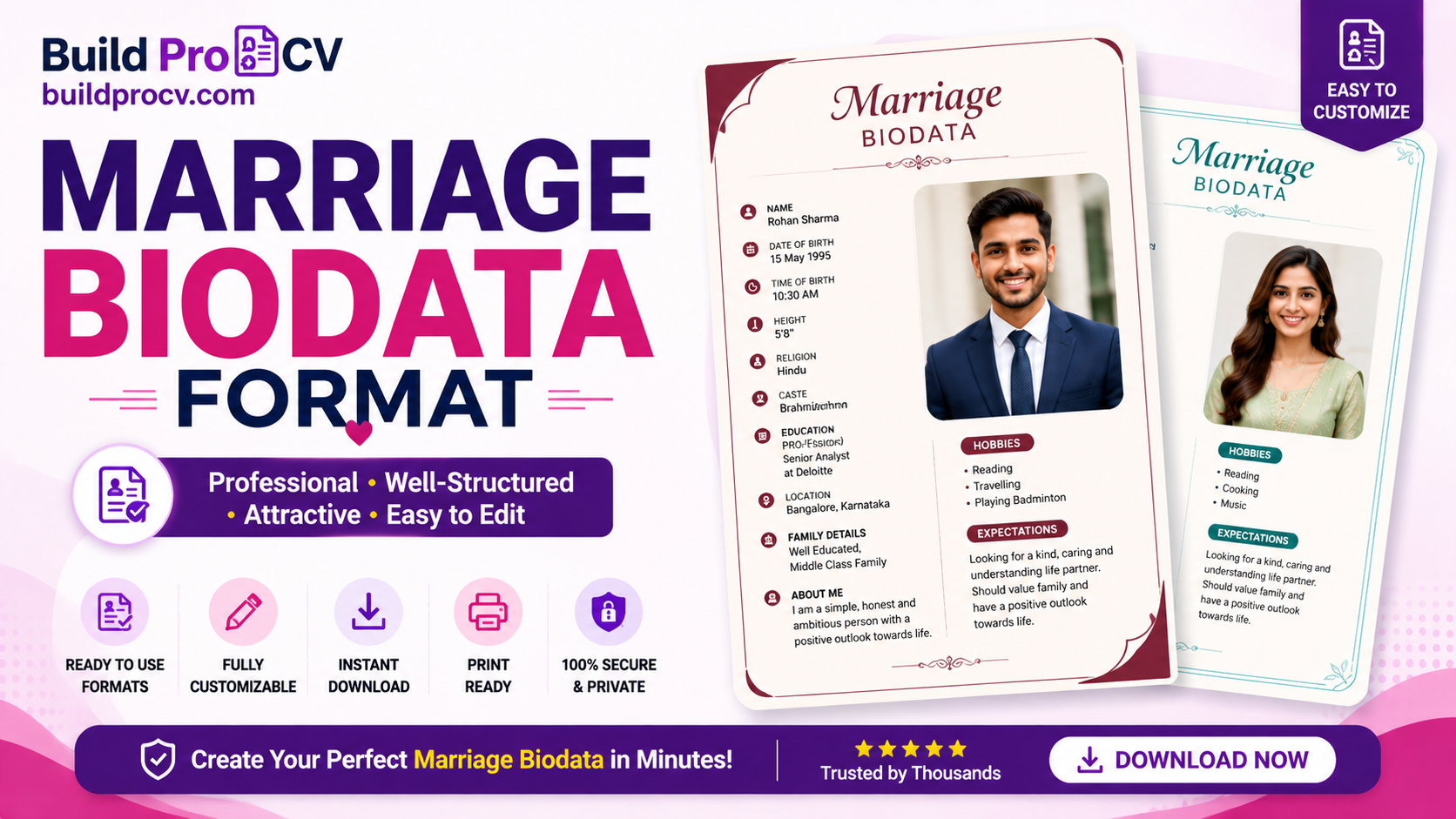
A marriage biodata is the first impression your family shares when a match is being considered — so it’s worth getting right. Done well, it’s a clean one-page snapshot of who you are: your background, your family, your education and work, and how to reach you. Done poorly, it’s cluttered, hard to read, or missing the details people actually want to know.
This guide walks you through exactly what a marriage biodata should contain, shows you filled-in examples for both a prospective groom and bride, and shares simple formatting tips. At the end, you’ll see the fastest way to create your own.
What is a marriage biodata?
A marriage biodata is a short document, usually one page, that introduces a person to a prospective partner’s family for the purpose of arranged marriage. Think of it as a focused profile: instead of listing every detail of your life, it highlights the things families typically want to know first — religion and community, age, height, education, occupation, and family background.
It’s similar in spirit to a resume, but the purpose is different. A resume sells your professional skills to an employer; a biodata introduces you and your family in a respectful, personal way. (If you’re curious about the differences, we cover biodata vs resume in a separate guide.)
What to include in a marriage biodata
A good biodata is organised into clear sections. Here’s what each one should cover:
Personal details — Full name, date of birth, age, height, religion, caste or community (if relevant to your family), mother tongue, and marital status.
Education and career — Your highest qualification, and your current job title and company or profession.
Family details — Father’s name and occupation, mother’s name and occupation, and brief details of siblings (and whether they’re married).
Contact details — A phone number and, if you wish, an email address, usually of a parent or guardian who is managing the conversation.
Photo — A clear, recent, modest photograph. One good photo is enough.
You can also add a short line about your hobbies, values, or what you’re looking for in a partner — but keep it brief and genuine.
Marriage biodata example — for a prospective groom
Here’s a complete sample you can use as a model. (All details are fictional.)
Personal Details
- Name: Rohan Mehta
- Date of Birth: 14 August 1996 (Age 29)
- Height: 5 ft 10 in
- Religion / Community: Hindu, Maheshwari
- Mother Tongue: Hindi
- Marital Status: Never married
Education & Career
- Qualification: B.Tech (Computer Science)
- Occupation: Software Engineer at a private IT firm, Pune
Family Details
- Father: Suresh Mehta, Businessman
- Mother: Anita Mehta, Homemaker
- Sibling: One younger sister (unmarried, pursuing B.Com)
About
- Hobbies: Cricket, reading, travelling
- A family-oriented person who values honesty and mutual respect.
Contact
- Phone: +91-XXXXXXXXXX (Father)
Marriage biodata example — for a prospective bride
Personal Details
- Name: Priya Sharma
- Date of Birth: 2 March 1998 (Age 27)
- Height: 5 ft 4 in
- Religion / Community: Hindu, Brahmin
- Mother Tongue: Marathi
- Marital Status: Never married
Education & Career
- Qualification: M.A. (Economics)
- Occupation: School Teacher, Nagpur
Family Details
- Father: Rajesh Sharma, Bank Manager
- Mother: Sunita Sharma, Homemaker
- Sibling: One elder brother (married, working in Bengaluru)
About
- Hobbies: Classical music, cooking, painting
- Caring and grounded, looking for an understanding life partner.
Contact
- Phone: +91-XXXXXXXXXX (Father)
Formatting tips for a good biodata
A few small things make a biodata look polished and trustworthy:
Keep it to one page if you can — families skim, they don’t read essays. Use clear section headings so the eye can jump straight to education or family details. Choose a simple, readable font and leave enough white space; a cramped biodata is hard to take seriously. Use one good photo, recent and clear, rather than several. And always double-check your contact number — a single wrong digit can quietly end a promising match.
Equally, avoid a few common mistakes: don’t exaggerate qualifications or job titles, don’t include overly personal financial details, and don’t make it so long that the important points get lost.
The easiest way to make your marriage biodata
You don’t need to design a biodata from scratch in Word or struggle with alignment. The free Shaadi Biodata Maker lets you fill in your details, add a photo, choose a clean format, and download a ready-to-share PDF in just a few minutes — no login and no watermark. It produces a neat, consistent layout that looks the same whether you send it on WhatsApp or print it for a meeting.
Once it’s ready, you’ll have a one-page biodata you can confidently share with prospective families.
Frequently asked questions
What should I write in a marriage biodata?
Include your personal details (name, date of birth, height, religion, community), your education and occupation, your family details, contact information, and a recent photo. A short line about your hobbies or values is a nice touch.
How long should a marriage biodata be?
Ideally one page. It’s meant to be a quick, clear introduction, not a detailed life story.
Should I add a photo to my biodata?
Yes, one clear and recent photo is recommended. It helps families form a first impression.
Is a marriage biodata the same as a resume?
No. A resume is for job applications and focuses on professional skills, while a biodata introduces you and your family for marriage and focuses on personal and family details.
How can I make a marriage biodata for free?
You can use a free Shaadi Biodata Maker to fill in your details, add a photo, and download a formatted PDF in minutes without any sign-up.