
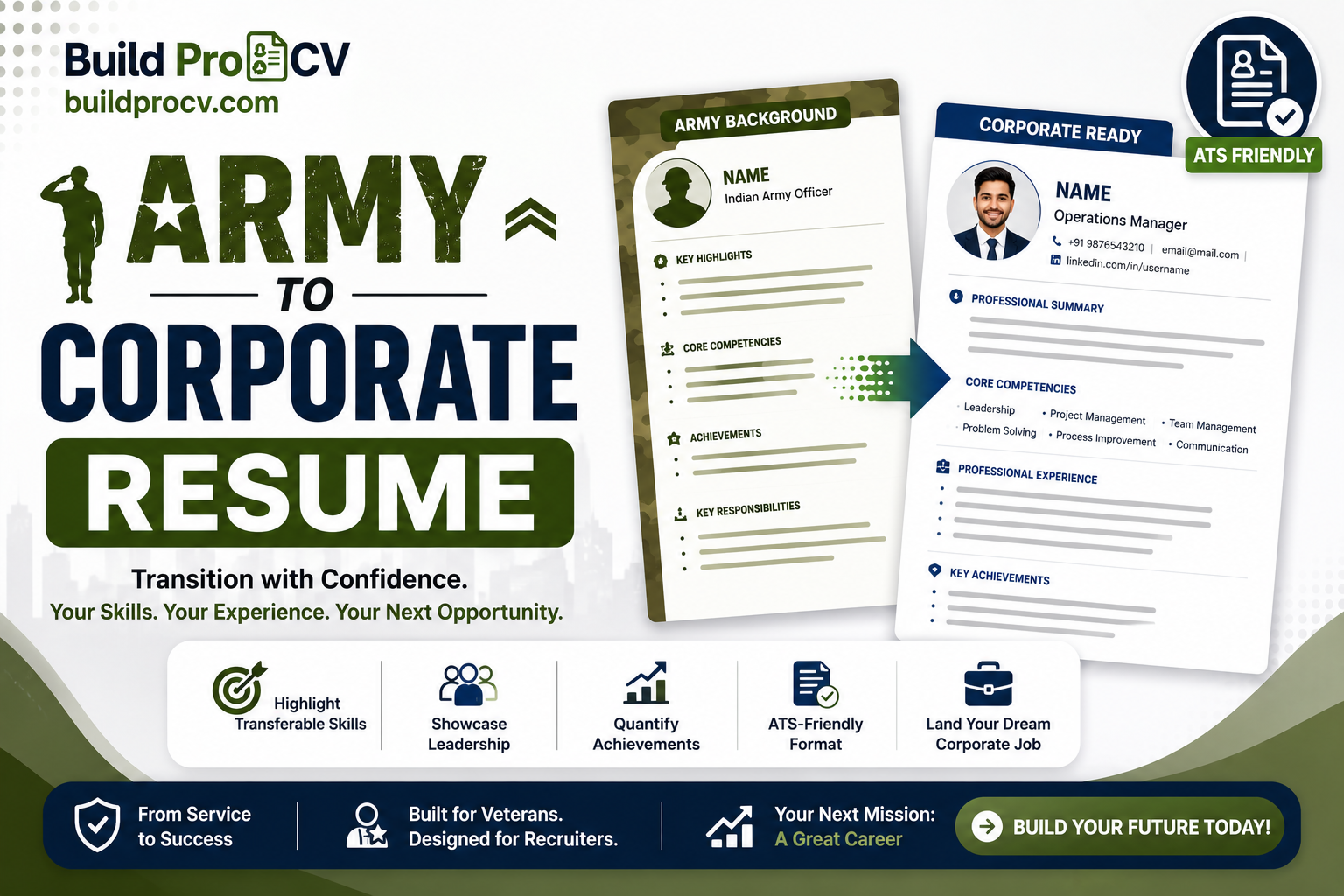
After years in uniform, you’ve led teams under pressure, managed people and resources, and delivered in conditions most civilians will never face. Then you sit down to write a resume for a corporate job – and it doesn’t land. Recruiters skim past it, applications go unanswered, and it’s hard to understand why, because the experience is clearly there.
The problem usually isn’t your experience. It’s translation. A corporate recruiter often can’t decode military ranks, trades and unit terminology, so your achievements don’t register the way they should. This guide shows you how to translate your military service into a resume that civilian employers immediately understand.
Why military resumes get overlooked
Rank and unit jargon. Titles like “Subedar Major” or “JCO”, or a specific unit designation, mean a great deal inside the forces but little to a civilian HR team. They describe seniority and belonging, not the corporate function you performed.
Untranslated duties. “Responsible for regimental administration” is accurate, but a recruiter reads it and isn’t sure whether you’d suit an operations, HR or admin role. The civilian equivalent isn’t obvious to them.
ATS software. Most companies filter resumes through applicant tracking systems that match your resume against the job description. Military terms rarely match civilian job keywords, so even a strong candidate can be screened out before a human looks.
The golden rule: translate, don’t transcribe
Don’t list what you did in military language and hope the reader works it out. Restate each role in the corporate terms a hiring manager already uses. You’re not exaggerating or hiding anything – you’re describing the same work in language your new industry understands.
How to translate your military experience
Lead with a civilian job title. Instead of your rank, use the corporate-equivalent designation for the role you performed – Operations Manager, Team Leader, Logistics Manager, Administrative Officer, Trainer, Security Manager, and so on.
Reframe duties as business functions. A few common examples:
- Led a platoon or company → Led and managed teams of 30–120 people
- Operational planning and command → Operations management; planning and execution under pressure
- Quartermaster / logistics role → Supply chain, inventory and asset management
- Signals / technical trade → IT, telecom or technical operations
- Adjutant / regimental admin → Administration, HR coordination and office management
- Instructor at a training establishment → Corporate trainer; learning & development
Quantify everything. Numbers translate across any field. State the size of teams you led, the value of assets or budgets you managed, the number of people you trained, the scale of operations you coordinated.
Show courses as certifications. Military training courses are real professional development. List them as certifications rather than as military courses.
Show medals as recognitions. Commendations and awards demonstrate performance. Present them as professional recognitions or awards, with a brief note on what they were for, rather than as decorations.
Drop rank, unit numbers and classified details. They add nothing for a civilian employer and can clutter or complicate the resume.
Make it ATS-friendly too
Once your experience is translated, make sure the format passes the software gate. Use a clean single-column layout, standard headings, and the keywords from the job description. It’s worth running your finished resume through a free ATS Score Checker to see your match score and catch any formatting issues before you apply.
Let the tool do the translation for you
Doing all of this manually takes time and a good feel for corporate language. The free Fauji2Corporate CV maker does the heavy lifting: you select your service, rank and trade, and it automatically produces a corporate-equivalent designation, a professional summary, relevant skills, and work experience written in civilian terms — with your rank kept off the CV entirely. You can edit every section, pick a template, and download a polished PDF in minutes. It’s the fastest way to turn years of service into a resume the corporate world understands.
Frequently asked questions
How do I put military experience on a corporate resume?
Translate each role into its civilian equivalent — use a corporate job title instead of your rank, describe duties as business functions, quantify your impact, and list courses as certifications and awards as professional recognitions.
Should I mention my rank on a civilian resume?
Generally no. Rank means little to civilian recruiters and can confuse the picture. Lead with the corporate-equivalent role you performed instead.
What corporate jobs suit ex-servicemen?
Common fits include operations, administration, logistics and supply chain, security management, training and L&D, facilities, and project coordination — but your specific trade may open many more.
How do I get my military resume past an ATS?
Use a clean single-column layout with standard headings, include keywords from the job description, and check it with an ATS score checker before applying.
Is there a free tool to make an army-to-corporate resume?
Yes. A free Fauji2Corporate CV maker lets you select your service and trade and automatically translates your experience into a corporate resume you can download as a PDF.